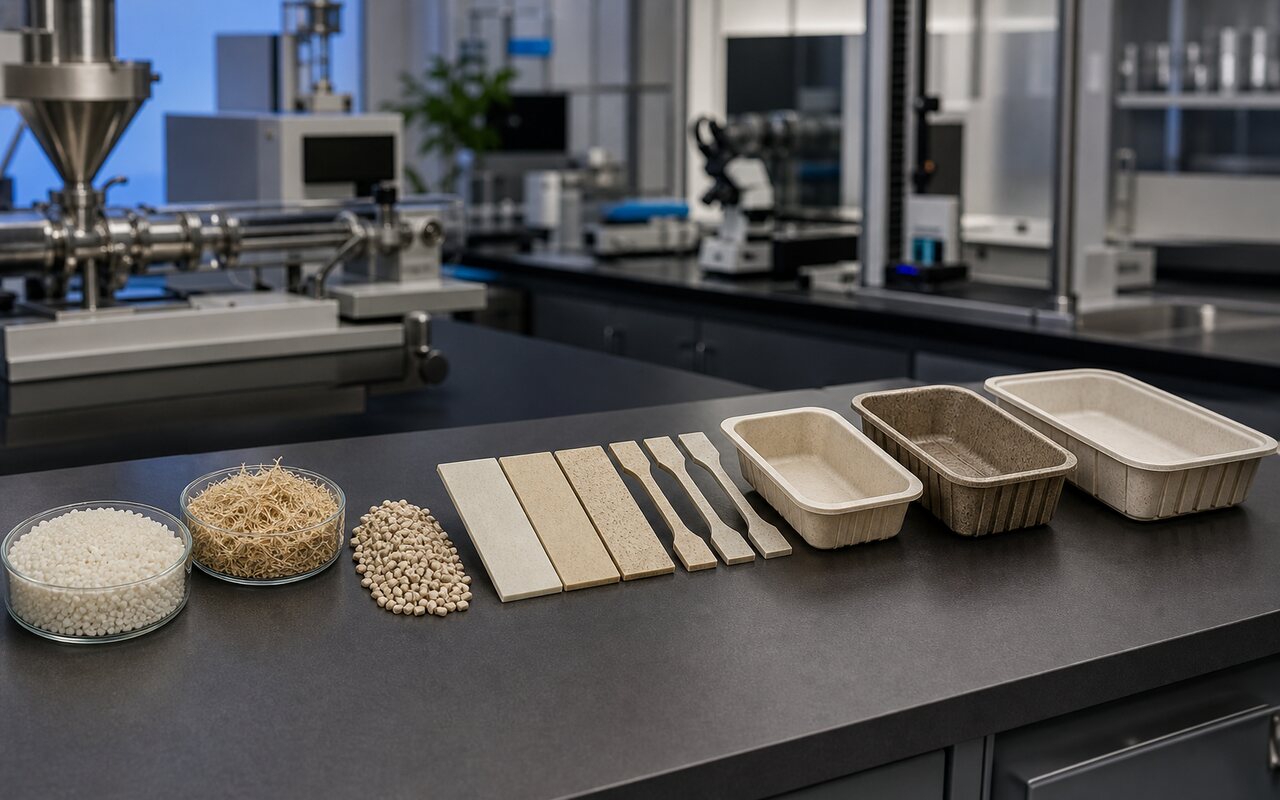
We began by narrowing the promise
The project did not start with a request for the “best sustainable tray”. That would be too broad to calculate honestly. We defined a rigid tray for dry products at ambient temperature and explicitly excluded hot fill, oven use, medical use, food-contact certification and compostability claims.
The objective was practical: explore predominantly bio-based formulations while balancing conservative stiffness, density, bio-based content, a configurable raw-material cost scenario and preliminary processing compatibility. Every output would remain a computational candidate until tested.
Then we made every input accountable
The initial material system combined a base polymer, a secondary biopolymer, a cellulosic reinforcement and a citrate plasticizer. Each usable reference value was stored with its unit, source and import context. Prices were kept separate as a dated commercial scenario rather than treated as scientific properties.
One gap immediately mattered: the available plasticizer reference did not provide a sufficiently supported stiffness input for this study. We did not ask an intelligent assistant to guess it. Candidates containing that component could be generated, but they were not assigned a stiffness result and therefore could not enter the fully evaluated comparison.
The design space became visible
Within the configured one-percentage-point composition ranges, the live run generated 4,575 mass-balanced formulations. Each record preserved its component percentages and passed the same structural checks. The run was deterministic, so its inputs and versioned protocol can be reproduced.
Of those candidates, 491 had all the inputs required for the supported comparison. The other 4,084 were retained in the rejection analysis with an explicit missing-data reason. That number is not a failure; it reveals exactly which reference information would unlock a broader study.
We calculated only what the evidence supported
For the evaluated candidates, ChemNexum calculated composition-derived quantities and the selected cost scenario, and produced first-order engineering estimates for supported physical properties. Each result carried an evidence class, assumptions and source links.
Actual tensile strength, elongation, impact resistance, permeability, industrial thermoformability, biodegradation time and compliance were not generated. The public result labels them as not currently modelled. A blank backed by scientific honesty is more useful than a precise-looking fiction.
Trade-offs replaced the search for a perfect answer
The comparison considered four competing goals. Twenty-one candidates formed the non-dominated trade-off set: none could improve every objective at once without giving something up. A separate preference score helped navigate the set but was never presented as a universal scientific ranking.
ChemNexum then selected eight deliberately different recommendations rather than eight neighbours. Three of those became laboratory priorities, providing a small experimental programme designed to compare distinct composition regions.
The result is a beginning, not a certification
The proposed next step is physical preparation, dimensional and density checks, mechanical and thermal characterization, processing observation and a tray-forming trial under an appropriate laboratory protocol. Measured values can later be entered beside their computational counterparts.
That is the point of the benchmark. It did not make an industrial material. It transformed thousands of declared possibilities into three traceable questions that are worth taking into a laboratory.
KEY POINT
The live benchmark reduced 4,575 possible compositions to three diverse laboratory priorities while keeping unsupported properties visibly unsupported.